By Dr. Lattanzio-Kotsiris, PT, DPT
Many people are talking about hypermobility and pelvic floor dysfunction – but what do these conditions actually have to do with one another? In this month’s post we will distinguish between generalized hypermobility disorders and Ehlers-Danlos Syndromes and how both can impact your pelvic floor.
Hypermobility vs. Ehlers-Danlos Syndromes
Hypermobility
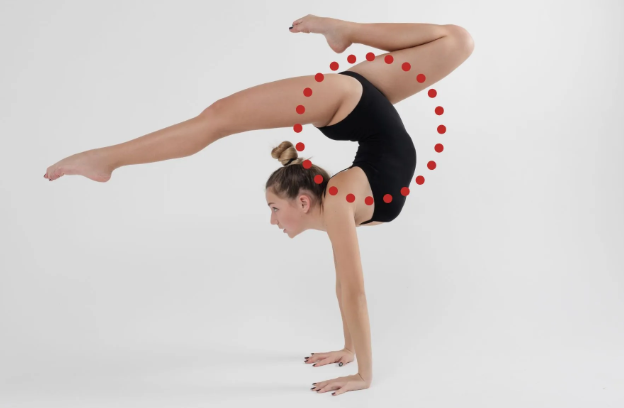
Hypermobility is defined as a joint moving beyond its active and/or passive normal physiological limits. Joint hypermobility is not always negative and is somewhat common in the general population, and can occur without complications. There are also forms of acquired hypermobility that may be present in dancers, gymnasts, wrestlers, cheerleaders, and other athletes where hypermobility is trained and is thus not indicative of a disorder. If a hypermobile individual denies joint dislocations or subluxations, or feelings of instability/mistrust in their joint integrity, hypermobility isn’t something that necessarily needs treatment. When joints are adequately stabilized by muscles and tendons, hypermobility of the joints can be disguised and managed without medical intervention.
Most people with hypermobile joints remain asymptomatic throughout their life and are labeled as “asymptomatic joint hypermobility” as they are without symptoms or complications. An individual may be categorized as having “symptomatic joint hypermobility” if they present with weakness, reduced mobility, and/or muscle hypertonicity in proximity to a hypermobile joint. This can lead to altered movement patterns, joint dislocations/subluxations, musculoskeletal overuse injuries and/or pain. Patients with symptomatic joint hypermobility that do not meet the criteria for hEDS are often labeled as HSD (hypermobility spectrum disorders).
Ehlers-Danlos Syndromes
Ehlers-Danlos Syndromes (EDS) are a group of inherited disorders caused by gene variants responsible for collagen synthesis and production. There are 13 distinct subtypes of EDS, with more identified as more gene variants are discovered. EDS varies according to specific subtype, but most include a degree of skin hyperextensibility, joint hypermobility and/or fragility of skin, soft tissues and certain internal organs. The true prevalence and incidence of EDS in the general population is unknown.
Hypermobile Ehlers–Danlos syndrome (hEDS) is the most common subtype of EDS and is the only subtype that does not have a known genetic variant and thus no genetic testing is available at this time. Diagnostic criteria for hEDS relies on subjective reports, objective measurements and scales, and exclusion of other possible diagnoses.
Hypermobile EDS varies in degree of severity between individuals. Multiple body systems may be impacted, and the presence of several comorbidities is common, including chronic pain, autonomic dysfunction, psychological disorders, postural orthostatic hypotension (POTS), mast cell activation syndrome (MCAS), and bowel/bladder dysfunction.
Pelvic Floor Dysfunction
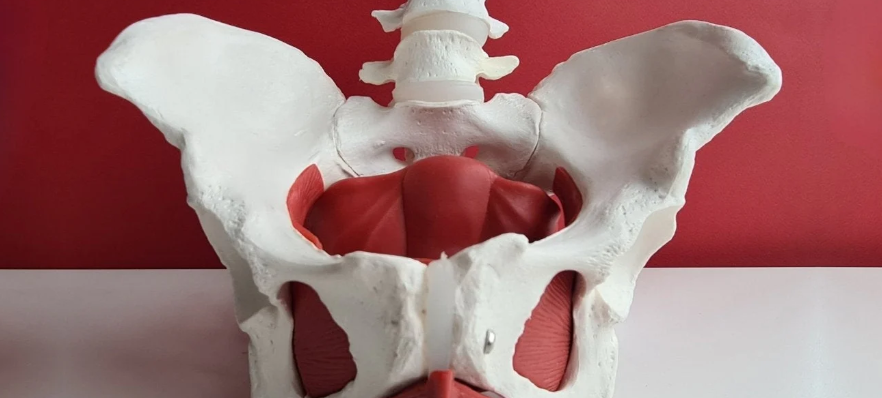
Pelvic floor dysfunction (PFD) is a disorder of the muscles, fascia, ligaments, vascular and/or nerves of the pelvic girdle and can present as:
Urinary incontinence
Pelvic organ prolapse
Fecal incontinence
Pelvic pain
Constipation
Painful intercourse
Like hEDS, the prevalence and incidence of PFD is unknown due to poor diagnostic criteria and lack of patient reporting. However we do know that both PFD and hEDS are more common in women (again this could however be due to poor reporting in the male population). PFD can lead to a sizable reduction in quality of life and can be associated with psychological disorders.
We have written extensively about pelvic floor dysfunction in other blog posts for additional information.
Ehlers-Danlos and Pelvic Floor Dysfunction
Individuals who are diagnosed with hEDS (and other forms of EDS as well) are more likely to present with urinary, pelvic organ prolapse, and colorectal symptoms. These symptoms are often more severe in those with hEDS compared to the general population, resulting in a lower quality of life.
EDS is a collagen disorder, and collagen disorders are a risk factor that can predispose or decompensate the pelvic floor. Individuals with hEDS are at higher risk of pelvic organ prolapse (and other pelvic floor symptoms) due to a reduction in structural integrity of the pelvic floor connective tissues. You can imagine the tissue being more “stretchy” and thus weak and dysfunctional leading to pelvic floor conditions. When the pelvic floor support system is weakened by faulty collagen, the pelvic floor muscles may have to overcompensate to keep everything in place. Over time, this can lead to muscle tension, poor coordination, and even pain. People with hEDS typically present with overlapping symptoms of both a hypotonic and hypertonic pelvic floor.
There’s no cure for EDS, but pelvic floor physical therapy is an effective Ehlers Danlos Syndrome treatment to improve your quality of life.
Still have questions? Contact us for more information!
Approved by Dr. Lattanzio-Kotsiris, PT, DPT